
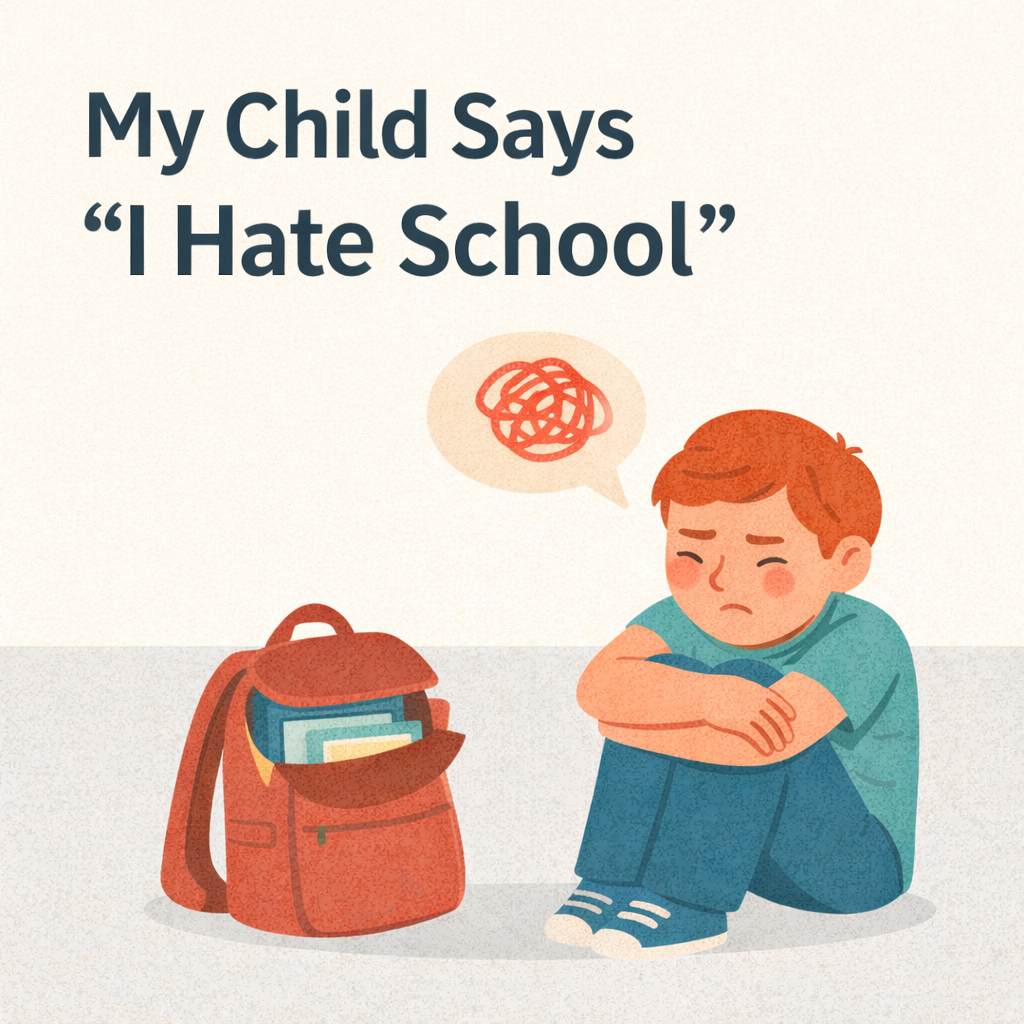
My Child Says “I Hate School”
We’ve heard those three words from hundreds of kids.
We’ve heard them in a principal’s office.
We’ve heard them whispered in a hallway.
We’ve heard them said with tears.
We’ve heard them said with crossed arms and defiance.
And we’ve heard them at our own kitchen table.
When your child says, “I hate school,” it hits you in the gut. Especially if you value education. Especially if you loved school. Especially if you’ve built your life around it.
Your first instinct might be to correct them.
“You don’t hate school.”
“School is important.”
“You have to go.”
“You’ll understand one day.”
But here’s what we’ve learned — as a principal, a pediatrician, and as parents:
When a child says they hate school, they’re almost never talking about school.
They’re talking about something underneath it.
The Third-Grade Breakdown
I (Adam) remember a third grader who landed in my office one morning refusing to go back to class. Arms folded. Backpack still on. Absolute shutdown mode.
“I hate school,” he said.
Now, this was a kid who had loved school the year before. So I didn’t argue. I didn’t convince. I just asked, “What happened?”
After a long pause, he said, “I’m bad at reading out loud. Everyone knows.”
There it was.
He didn’t hate school.
He hated feeling exposed.
He hated feeling behind.
He hated that pit in his stomach when his name was called.
When we slowed down and unpacked it, we were able to put supports in place. Extra reading practice. A heads-up before he had to read aloud. A teacher who quietly built his confidence instead of putting him on the spot.
Two months later? Different kid.
The words “I hate school” were really code for “I feel small.”
Sometimes It’s Not Academic
Other times, it has nothing to do with grades.
A middle schooler once told me (Jaclyn) she hated school. After some gentle conversation, it came out that she had no one to sit with at lunch.
That’s it.
Academically strong.
Athletically involved.
But lonely.
For kids, social pain is school pain. If it hurts in the cafeteria, it hurts everywhere.
What Not to Do
Let us say this clearly:
Don’t minimize it.
Even if it feels dramatic.
Even if it feels temporary.
Even if you think they’ll “get over it.”
When a child says they hate school, they’re trusting you with a feeling. If we dismiss it too quickly, they stop bringing us the hard stuff.
And we want the hard stuff.
What To Do Instead
1. Get Curious Before You Get Corrective
Instead of responding with logic, respond with curiosity.
- “Tell me more.”
- “What’s making it feel that way?”
- “When did you start feeling this?”
You’re not interrogating. You’re inviting.
Most kids don’t have the language to articulate what’s wrong immediately. You may need a car ride. A walk. A bedtime conversation in the dark.
Patience beats pressure.
2. Look for Patterns
Is it every day? Or just Sundays?
Is it one subject? One teacher? One peer?
Did it start after a specific event?
Hate is often situational.
When you find the pattern, you find the lever.
3. Partner With the School — Don’t Weaponize It
As a former principal, I can tell you: educators want to know.
But how you approach them matters.
Instead of:
“My child hates your class.”
Try:
“My child has been struggling and I’d love to work together to figure out what’s going on.”
That posture changes everything. Now it’s not parent vs. teacher. It’s adults aligned around a child.
4. Separate “Hard” From “Harmful”
Sometimes school is hard.
Sometimes it’s uncomfortable.
Sometimes growth feels frustrating.
That’s normal.
But harmful is different.
If your child feels unsafe, persistently targeted, humiliated, or anxious to the point of physical symptoms — that’s not just “school is hard.” That deserves immediate attention.
As parents, we have to discern the difference.
5. Teach Them Language
One of the most powerful things we can do is help kids refine their feelings.
Instead of “I hate school,” maybe it becomes:
- “Math feels overwhelming.”
- “I feel nervous during presentations.”
- “I don’t feel included at lunch.”
- “I’m bored.”
Clarity creates solutions.
Vagueness creates helplessness.
A Word to Parents Who Loved School
If you were a kid who thrived in school, this can be especially confusing. You might think:
How can you hate school? It’s full of opportunity.
But your child isn’t you.
Different wiring.
Different strengths.
Different social dynamics.
Different era.
Our job isn’t to recreate our childhood experience for them. It’s to help them navigate theirs.
The Long Game
Here’s the hopeful part:
Very few kids truly hate school long-term.
What they hate is a season.
A situation.
A struggle.
When we slow down, listen deeply, and partner wisely, those seasons usually pass.
And sometimes, the very thing they once said they hated becomes the place they find confidence.
I’ve seen it happen.
Over and over.
So when your child says, “I hate school,” don’t panic.
Lean in.
There’s a story underneath those words.
And if you’re patient enough to uncover it, you just might help them rewrite it.


